


Multi-currency payment processing has moved from a nice-to-have to a finance infrastructure question. When a business buys from vendors in Europe, pays contractors in Asia-Pacific or manages subsidiaries that settle in different local currencies, the payment itself is only part of the job. Finance also has to manage foreign exchange (FX), fees, settlement timing, audit trails and reconciliation across systems.
That pressure is not getting lighter. Global merchandise trade reached more than $26.2 trillion in exports in 2025, according to the World Trade Organization, and the Bank for International Settlements says global FX markets turn over $9.5 trillion per day. If your team is still stitching together bank portals, spreadsheets and ERP records, how much control do you really have once money leaves the system?
Key highlights
- Multi-currency payment processing is the ability to send, receive and reconcile payments in more than one currency while keeping amounts, FX details and accounting records aligned.
- The biggest gains come from tighter control over FX handling, approval workflows, payment visibility and reconciliation across subsidiaries and banking partners.
- The biggest risks come from exchange rate swings, fragmented payment systems, settlement delays and manual reconciliation after the fact.
- Zone & Co brings multi-currency payment processing directly into NetSuite with ERP-native workflows for procurement, payments and reconciliation.
What is multi-currency payment processing?
Multi-currency payment processing is the ability to initiate, route, settle and reconcile payments in more than one currency while preserving accurate accounting records in the enterprise resource planning (ERP) system. In practice, that means a finance team can approve a payment in one currency, settle it in another if needed, apply the right foreign currency and FX details and still close with confidence.
This matters because international business rarely runs on one currency. Vendors want to be paid in their local currency. Subsidiaries operate with different functional currencies. Treasury wants visibility into cash movement and finance wants a complete audit trail. That’s why global teams rely on a payment processor or multi-currency payment gateway that can do more than move funds. It has to connect execution with controls, reporting and accounts payable.
Benefits of a comprehensive multi-currency payment solution
A strong multi-currency payment solution does more than let you pay in different currencies. It removes the handoffs that create extra risk after invoice approval but before the transaction is fully reconciled.
The real value is in daily finance operations. Can your team see the payment status without leaving the ERP? Can it track FX impact at the transaction level? Can it avoid turning every exception into manual cleanup work?
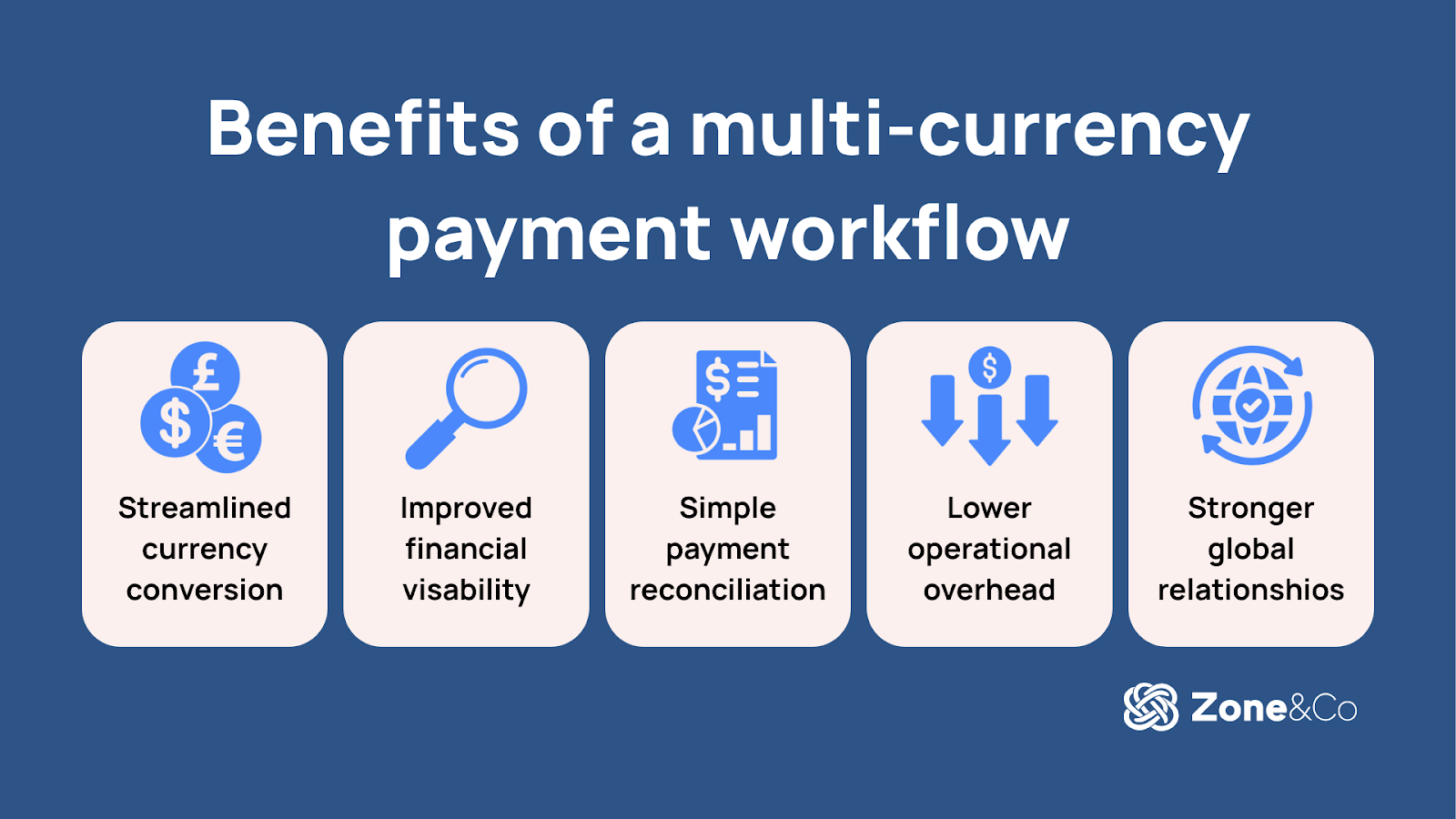
Streamline currency conversion
FX issues rarely start at close. They start earlier – when rates shift between approval and payment, when bank portals apply unclear spreads or when currency data sits outside the ERP.
A stronger workflow gives finance visibility into rates at the moment of payment. That means fewer surprises, cleaner records and less time spent explaining gains, losses and variances after the fact.
Multi-currency payment processing can streamline currency conversion by:
- Cutting manual FX rekeying between bank portals and the ERP
- Improving visibility into rate application and final transaction value
- Reducing payment exceptions tied to mismatched currency data
Improve financial visibility
Multi-currency payments create blind spots fast when approvals, payment execution and settlement status live in different systems. Finance ends up chasing answers instead of managing cash and liabilities.
Bringing those steps together gives teams a clearer view of what has been approved, what has been paid and what still needs attention. That improves control without adding more reporting work.
Adding a comprehensive multi-currency payment into your workflow helps finance teams:
- Track payment status without leaving the ERP.
- See liabilities, approvals and settlements in one place.
- Strengthen audit trails across entities and currencies.
Simplify payment reconciliation
This is where many teams lose the value of automation. Payments move, but payment reconciliation still depends on manual matching, fee tracking and follow-up work across systems.
A better multi-currency workflow keeps payment and accounting records connected from the start, and allows teams to:
- Match invoices and payments faster across currencies.
- Reduce manual work tied to fees, FX differences and partial settlements.
- Keep payment records aligned with accounting data.
Lower operational overhead
Manual multi-currency payments create work that finance never asked for. Exporting files, switching portals, checking details and updating records all pull skilled staff into low-value admin.
Keeping payments inside the ERP removes those handoffs and will:
- Reduce exports, uploads and duplicate entries.
- Cut back on bank portal work and approval follow-up.
- Pay vendors directly in the ERP.
- Free finance capacity for higher-value work.
Strengthen global vendor relationships
Vendors care about one thing first – getting paid accurately, on time and in the right currency. When that breaks down, supplier trust takes the hit.
A reliable multi-currency process helps finance deliver a more consistent payment experience across regions. That lowers friction, supports stronger supplier relationships and helps the business scale internationally without making payments harder to manage.
With a solid foundation of multi-currency payment processing, teams can:
- Pay vendors in their preferred currencies.
- Improve payment predictability across regions.
- Support ERP-native global payments without adding another disconnected layer.
How multi-currency transactions work
The easiest way to understand multi-currency transactions is to follow one payment from start to finish.
Say a U.S. entity approves an invoice from a supplier in Germany. The bill sits in the ERP, the supplier wants to be paid in euros and the paying entity holds funds in U.S. dollars. Several steps have to line up behind the scenes for the payment to go out accurately, settle cleanly and reconcile back to the original invoice.
1. The invoice is approved for payment
The process starts when finance selects an approved vendor bill for payment and confirms the key details. That includes the paying entity, beneficiary information, payment amount and the currency the supplier expects to receive.
This is where control starts to matter. If the wrong bank details, entity or currency are attached to the payment, the issue rarely stays contained. It usually shows up later as a delay, a failed payment or extra cleanup work for AP and accounting.
2. The currency is converted
Because the payment is funded in U.S. dollars and settled in euros, the payment provider applies an exchange rate before the funds are sent. That currency conversion rate determines the final value of the transaction and how much the supplier receives.
This is also where finance either gets clarity or loses it. If the conversion logic is visible, the team can understand the final payment amount before settlement. If it is hidden inside a bank portal or external payment system, finance is left explaining realized gains, losses or variances after the payment is already complete.
3. The payment is routed across borders
Once the amount is set, the payment moves through the appropriate rail based on the country, currency and banking requirements. That might be a local clearing network, a wire or another cross-border route depending on the vendor and payment setup.
Routing has a direct impact on cost, timing and reliability. The right route can lower fees and help the payment land faster. The wrong one can introduce delays, extra charges or failed transactions that create friction with vendors and more follow-up work for finance.
4. The supplier receives the funds
After the payment is sent, the transaction settles into the supplier’s account. The payment partner then returns the final settlement details, including confirmation of delivery, timing and any fees or deductions applied along the way.
A payment marked as sent is not the same as a payment fully settled. Finance still needs to know what actually arrived, when it arrived and whether anything changed between approval and final delivery.
5. Finance reconciles the result
The last step is matching the settlement record back to the original invoice in the ERP. Finance can then confirm the liability was cleared, review any FX impact and keep a clean audit trail from approval through payment.
When reconciliation is connected to the original workflow, close gets easier and reporting gets cleaner. Otherwise, the team ends up reconstructing the payment after the fact, which is exactly where multi-currency complexity starts to drag on finance.
Which AP automation platforms support multi-currency payments?
Finance leaders asking which AP automation platforms support multi-currency payments usually mean something more specific: Which platforms can support international vendor payments without turning reconciliation into more manual work?
This also connects to a broader architecture question. If you are already thinking about a scalable billing system, why keep AP payments fragmented on the other side of the house?
How to evaluate vendors offering multi-currency payment processing
Not every vendor offering multi-currency payment processing solves the same problem. Some are strong at payment rails. Some are strong at AP workflow. Some do both, though only with more integration work.
A finance leader should look past the headline claim and ask a harder question: Where does the process actually happen, and who cleans up the exceptions?
A strong shortlist usually shares five traits:
- Native ERP integration
- Clear handling of currencies, rates and settlement data
- Broad payment coverage without forcing every transaction through expensive rails
- Reliable reporting and reconciliation controls
- AP automation that keeps the full procure-to-pay workflow connected
Streamline your NetSuite multi-currency payment workflow with Zone & Co
Zone is positioned for finance teams that want multi-currency payment processing to happen inside the ERP, not outside it. The current AP stack combines procurement, vendor management, invoice capture, approvals, vendor payments and reconciliation in NetSuite and connects to a broader, end-to-end financial workflow for teams.
Key capabilities include:
- AI-powered procurement and vendor onboarding
- Invoice capture and coding inside NetSuite
- Flexible approval workflows
- Cross-border vendor payments in 140+ currencies
- Real-time payment status visibility
- Reconciliation support across banks, cards and payment service providers
- Support for entities, currencies and complex structures across global operations
Zone’s global AP Payments capabilities bring invoice capture, approvals, payments and reconciliation together to streamline the entire procure-to-pay process, and extends that model to domestic and global vendor payment execution with TransferMate-powered infrastructure. For NetSuite teams managing cross-border operations, that is a much cleaner answer than exporting approved bills and hoping the accounting catches up later.
Book a demo today and explore how your enterprise can streamline global vendor payments with Zone & Co.