
What is subscription billing?
See subscription billing in action →Subscription billing is the process of charging customers on a recurring schedule – monthly, quarterly or annually – for ongoing access to a product or service. It’s the go-to billing model for SaaS, media, professional services and any business with recurring revenue.
When subscription billing runs well, customers are charged accurately and on time, cash flow is predictable and the finance team closes quickly. But when teams handle subscription billing manually, it’s easy for revenue leaks, disputed invoices and bottlenecked reconciliation to happen.The challenge with subscription billing is managing everything that changes mid-contract.
Why subscription billing matters
If a customer upgrades their plan mid-month, finance has to figure out what to bill, when to bill it, how to prorate the difference from the old plan and how to update the revenue schedule in enterprise resource planning (ERP) platform to reflect a contract that looks nothing like the one that was in the system yesterday. If that happens 20 times a month across a mix of monthly, annual and usage-based contracts, the billing function starts to consume more time than it should – and the revenue close becomes a reconciliation project.
Common challenges with subscription billing
Letting customers and clients hold the power to update their plans mid-contract and providing flexibility is what helps your business close deals, but it comes with complexity in your back-office operations.
Managing amendments, upgrades and cancellations
Subscription billing becomes operationally complex when contracts change mid-cycle. Upgrades, downgrades, seat changes and cancellations all require accurate proration and contract amendments. Without a system that handles these automatically, finance teams spend significant time manually adjusting invoices and reconciling billing records against the ERP.
Consolidating invoices and multi-currency billing
Companies with multiple product lines, billing frequencies or international customers face consolidated invoicing and multi-currency challenges. Sending a single invoice for multiple subscriptions, handling FX conversion correctly and applying the right tax treatment across regions are all points of failure when billing runs outside the ERP.
Revenue recognition complexity
Subscription billing is directly connected to revenue recognition. When a customer pays upfront for a 12-month subscription, revenue must be recognized over the contract period in accordance with ASC 606 – not at the point of payment. Managing this correctly requires a system that links billing data to revenue schedules and handles contract modifications automatically.
How teams improve subscription billing
Effective subscription billing requires connecting the billing process directly to the ERP and automating the steps that change with every contract modification:
- Centralize contract data in the ERP: Store all contract terms – billing frequency, amount, start and end dates – inside NetSuite so that billing events generate automatically without manual triggers.
- Automate billing cycle generation: Configure billing rules by contract type so invoices are created and sent on the correct schedule without manual intervention for each renewal.
- Handle amendments and proration automatically: When a customer upgrades, downgrades or cancels, the system should recalculate the billing amount and prorate automatically rather than requiring manual adjustment.
- Connect billing to revenue recognition schedules: Link each billing event to the appropriate revenue recognition schedule inside the ERP so that recognized revenue stays in sync with contract terms and ASC 606 requirements.
- Support multiple billing models in one system: Fixed recurring, usage-based and hybrid contracts should all be manageable within the same billing platform without separate workarounds for each model.
- Consolidate invoices and handle multi-currency: Generate single consolidated invoices for customers with multiple subscriptions and apply the correct FX conversion and tax treatment without manual calculation.

How ZoneBilling manages subscription billing
ZoneBilling automates subscription billing natively inside NetSuite by handling billing cycle generation, contract amendments, proration, consolidated invoicing and multi-currency billing without manual workarounds. Billing data flows directly into NetSuite's Advanced Revenue Management module, keeping revenue schedules aligned with contract changes automatically. Key capabilities include:
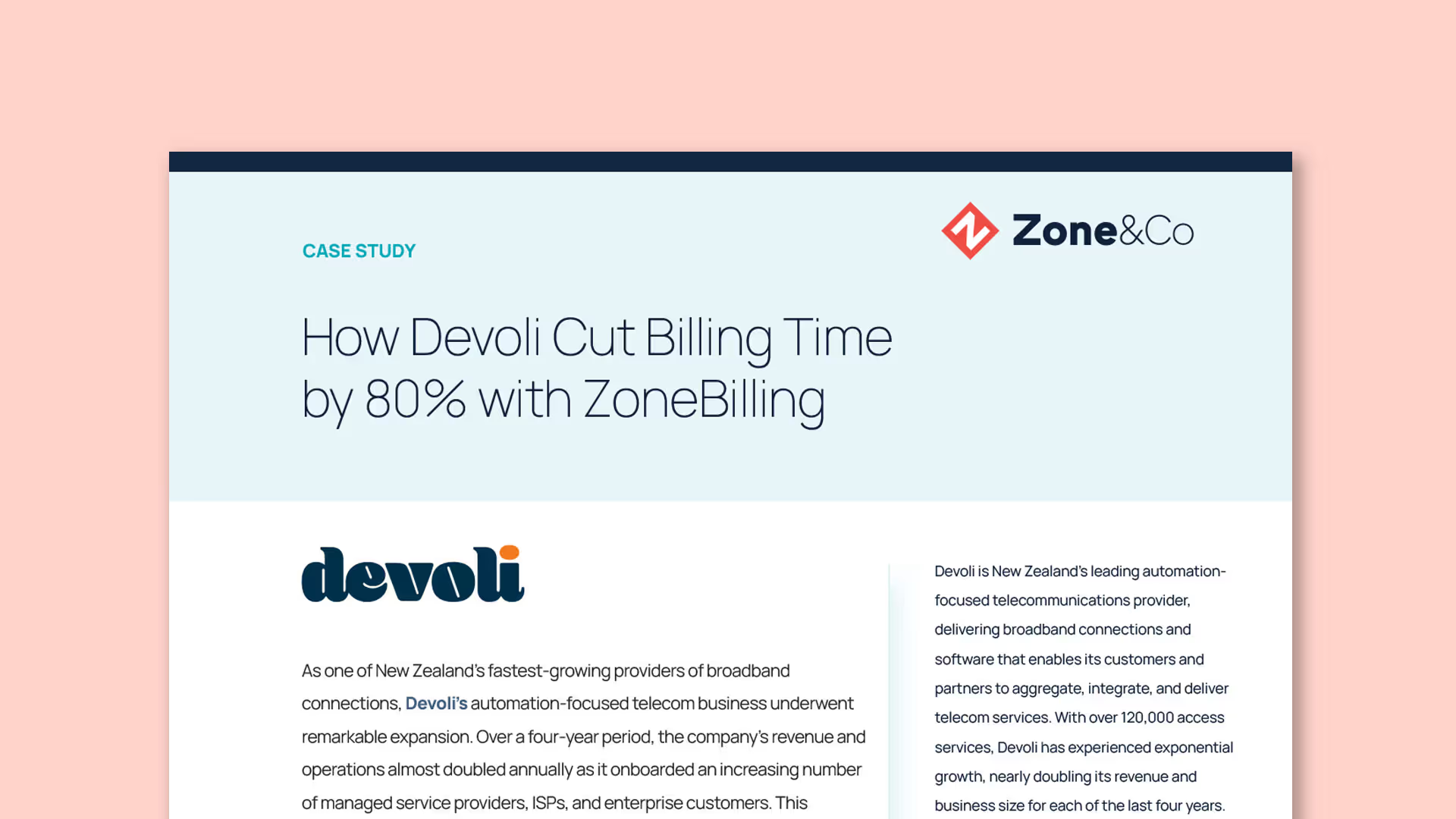
- Subscription billing and amendments: ZoneBilling automates recurring charges and handles mid-term updates without manual invoice rebuilding. Devoli cut its monthly billing cycle from five days to one day, saving 80% of the manual billing workload.
- Easy adjustments and credit memos: When contract terms change, ZoneBilling runs credit and rebill logic in-app and keeps the transaction trail linked to the original record, so teams can trace amendments end-to-end without reconstructing the history during close.
- Streamlined consumption billing: ZoneBilling ingests usage data from any source, rates it automatically and supports tiered pricing, overages, minimums and billing in arrears — no spreadsheet calculations required. Power Factors decreased revenue booking time by 94% after deploying ZoneBilling.
- Wraparound revenue recognition: ZoneBilling wraps around NetSuite ARM so that when billing changes, revenue schedules update automatically under ASC 606 and IFRS 15. Sourcegraph reduced revenue recognition time by 70% with ZoneBilling.
- Consolidated invoicing and flexible account hierarchy: ZoneBilling supports consolidated invoicing across multiple subscriptions and dynamically represents parent-child customer relationships so billing stays accurate as organizational structures change.
Get a personalized demo to see how ZoneBilling simplifies subscription billing automation.








.avif)

.png)
